Primary Ethics
This article was published in Living Ethics: issue 83 autumn 2011
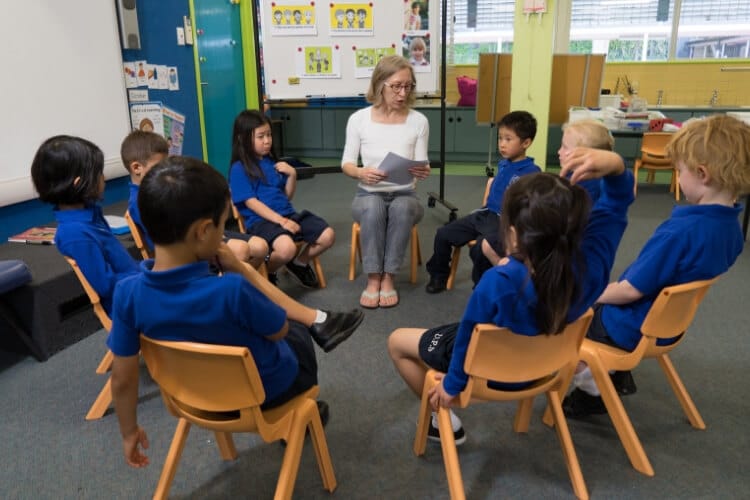
Following a successful pilot program and evaluation in 2010, the Centre is delighted that its ethics in schools program has now been endorsed by the NSW Government and has taken off across NSW. Teresa Russell reports on how the newly-established organisation Primary Ethics is working to deliver ethics classes to as many primary schools as possible.
Last year, St James Ethics Centre ran an ethics pilot program for primary school children who don’t go to scripture classes in NSW public schools. Despite loud opposition from a few faith groups who saw this option as a veiled attempt to remove scripture from schools, and because of the overwhelming public support for the initiative, the NSW Government gave the program the go-ahead.
After a campaign that started seven years ago, the NSW parliament passed an amendment to the Education Act (1990) on 1 December 2010, which enshrined the rights of children who don’t attend Special Religious Education (SRE)/Scripture in NSW public schools to attend philosophical ethics classes as an option to ‘private study’.
Labor, the Greens and several Independents voted for the legislation, while the Opposition Liberal/National Parties voted against it. However, the latter recently renounced its intention to cancel ethics classes, acknowledging that they were here to stay.
St James Ethics Centre was approved as the initial provider of classes in philosophical ethics. However, Primary Ethics, a new, independent, not-for-profit organisation has been established by the Centre to oversee all aspects of course delivery, including by providing trained volunteers and resources.
Primary Ethics ran its inaugural training workshops for ninety volunteer ethics teachers at the beginning of February 2011.
Chairman Bruce Hogan described the training that took place at the University of New South Wales on 1 to 2 February 2011 as a historical moment in education for NSW public primary schools.
This is just the first step in our long journey to deliver a quality curriculum through trained volunteer ethics teachers to all primary schools in the state, where parents would like that option for their children.
While he says the quality of volunteers selected for this first round of training is outstanding, Mr Hogan acknowledges that the fledgling organisation will struggle to meet the full demand for programs in schools across the state. There are 1641 public primary schools in NSW.
We’re delighted we were able to start 2011 with ninety classes in fifty-seven schools after getting the go-ahead just two months before, but now that school has started back, demand is on the rise. We’ll only be able to meet that demand if we can attract and retain thousands of volunteers.
Primary Ethics is a charitable enterprise that is only able to operate because of the extraordinary good will of many. This is a social enterprise operating without capital or any assured income. Volunteers and the spirit that motivates them for the good of children are our only assets
Primary Ethics plans to create an interconnected curriculum from K-6 and has started by rolling out curriculum for Years 5-6 children in 2011. Pilot programs for children in earlier stages of education will be developed over the next couple of years. This work will be accelerated if additional resources can be found.
The goals of the curriculum are:
- to provide a secular framework for examining ethical questions through argument and justification;
- to develop a child’s understanding of ethical issues;
- to build skills in ethical decision-making; and
- to foster the disposition to act ethically.
volunteer recruitment and training
Over the December-January school holidays, a core group of volunteers recruited Ethics Coordinators for sixty-nine schools across the state. Of these, fifty-seven schools were able to recruit ninety volunteers (including fourteen ethics teachers from last year’s pilot). Schools covered by the first group stretch from Alstonville, north of Byron Bay, down to Bateman’s Bay in the south and inland to Bungendore, near the ACT.
Who are the volunteers?
Recruitment and training of the right people is the crucial ingredient in starting the organisation off on the right foot. The quality of our volunteers will make or break us. Trained volunteer Ethics Teachers range in age from twenty-two to seventy-five and more than 25% of them are men, predominantly fathers. Most of the volunteers are highly educated and all of them are highly motivated to make the program succeed. Some are doing it for their children, to ensure that the program gets firmly established, while others simply want to make sure that ethics classes take hold and will remain an option for children who opt out of Scripture in future.
Throughout its campaign in the last few years, St James Ethics Centre promised that the ethics curriculum it developed would be given free of charge to Scripture providers to either use or modify for use within their religious framework. Primary Ethics will honour that promise.

latest articles